Wednesday, March 11, 2026

Gilbert Marion Heinz of Kickapoo Township

Gilbert Marion Heinz was born on May 17, 1924, in Kickapoo, Peoria County, Illinois, the fourth child of Alex P. and Rosella V. (Gilles) Heinz. Raised on the family farm, he was educated in the local community and helped with agricultural work until he joined the U.S. Army in 1943. During his service in the European Theater of World War II, he participated in the historic D-Day invasion at Normandy and fought in the Battle of the Bulge. He was wounded in the leg in France on August 20, 1944, earning the Purple Heart medal before receiving his honorable discharge in 1946.


Following the war, he returned to Illinois and married Ruth Cook Rogers on August 20, 1947, at St. Mary's Church in Kickapoo. Gilbert adopted Ruth’s son from a previous marriage, Michael Heinz (born November 6, 1946), who later married Norma Jean Rodriguez. Together, Gilbert and Ruth had five more children: Joyce E. Heinz (born August 27, 1948), who married Danny Laverne Baggott; Randall P. Heinz (born January 12, 1951), who married Karol Million; Cheryl R. Heinz (born November 1, 1954); Roland J. Heinz (born December 7, 1955); and Richard M. Heinz (born August 19, 1958). 


This chapter of his life was marked by tragedy when Ruth, at age 33, was killed in a two-car crash on the Interstate 74 bridge on March 31, 1962. Gilbert remarried Elinor Crowder Dunlap on January 16, 1965. In a heartbreaking repetition of fate, Elinor was also killed in an automobile accident on October 15, 1967, and was interred at St. Mary’s Cemetery in Kickapoo. 


In 1969, Gilbert found lasting companionship with Marilyn Arnold, whom he married in Missouri. They moved to Rushville in 1970 and had two children: Gilbert Heinz (born May 1, 1969) and Marnie Heinz (born February 7, 1971), who later married Brian Eskridge.


Professionally, Gilbert was known for his extraordinary work ethic, retiring in 2004 after more than 59 years as a bulldozer operator. He was a dedicated member of St. Rose Catholic Church in Rushville and the Schuyler American Legion Post 4. Gilbert passed away at the age of 81 on June 12, 2005, at OSF St. Francis Medical Center in Peoria. He was buried at St. Patrick Cemetery in Kickapoo following a funeral mass at St. Mary's Church. At the time of his passing, he was survived by his wife, Marilyn, his children, 24 grandchildren, and 19 great-grandchildren.


Schools of Kickapoo 1902

Prior to the adoption of the free school system there were very few public schools in Kickapoo Township. 

In 1840 Mr. Samuel Dimon, who had come to the township in 1838, hauled the logs for the first school house in what is now District No. 1. It was situated on the northeast quarter of Section 11, where the present school house now stands. In that house Miss Harriet Hitchcock is believed to have been the first teacher, Samuel Dimon afterwards taught there for two or three terms.

Prior to 1851 there was a school house some distance west of Hale's Mill, known as the Kingsley School House; but it is not known when or by whom it was built. 

In 1851 Miss Sarah Smith taught the first school at Hale's Mill, occupying a cooper shop for a school house. The school house, now located at Pottstown, is known as No. 4. 

The first school house in District No. 5 was located on the northwest quarter of Section 9. It was a frame building erected in the spring of 1851, at a cost of $260. The first school taught there was by H. Gregory, commencing in the fall of that year. This school house was replaced in 1877, by a modern frame house which cost $570.

The first school house in District No. 6 was erected on the southeast quarter of Section 16, in August, 1860. It was a frame building costing $300. School was commenced there in the fall of 1860 by a teacher named H. M. Behymer. 

The first school house in District No. 7 was erected in the summer of 1867 on the northeast quarter of Section 33. Miss H. Pritchard was the first teacher there. She commenced in the winter of that year. 

The first school house in District No. 8 was erected in the summer of 1867 on the northwest quarter of Section 13, at a cost of $528. The first school was taught there in the winter of that year by Miss Hattie C. Humison. 

The township is now well supplied with school houses of modern style, and the schools are in a prosperous condition. The Patrons of Husbandry at one time had a strong hold in this township, there having been two granges. No. 446 or South Kickapoo, new extinct, and Orange, having a Grange Hall on the northeast quarter of Section 11, It is one of the seven yet surviving in the county.

Tuesday, March 10, 2026

George F. Heinz Farm of Kickapoo Township


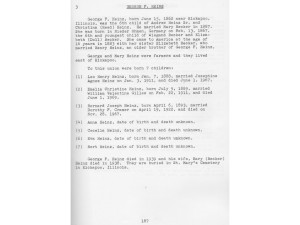
George F. Heinz was born on 15 June 1862 in Kickapoo, Peoria County, Illinois. He was the son of Andrew W. Heinz and Christina (Reed) Heinz. He grew up in the Kickapoo community, where the Heinz and Reed families were among the early settlers of the region.

In 1880, George was living in Kickapoo, unmarried, and listed as a son in the household. He married Mary A. Heinz Becker in 1887 in Peoria County, Illinois. Together they made their home in Kickapoo, where they raised their family and remained active in the local farming community.


George experienced the loss of both parents during his adult life. His mother, Christina, died on 11 June 1902 in Kickapoo, and his father, Andrew, died on 22 May 1907 in Kickapoo Township. By 1920, George was recorded as the head of household in Kickapoo, living with his wife Mary.

Mary died on 16 February 1938 in Kickapoo. George died the following year on 31 January 1939 at the age of 76 in Kickapoo, Peoria County, Illinois. They are buried at St. Mary's Cemetery in Kickapoo.

The 47-acre site on Route 150 that now serves as the Pringle Robotics headquarters carries a deep agricultural legacy, having once been the farm of George F. Heinz. As mentioned above, a descendant of German pioneers who settled in Kickapoo Township in the mid-1800s, George F. Heinz managed the land for decades, raising his family there alongside his wife, Mary Ann Becker.

Today, the property represents a unique bridge between Peoria’s history and its future; while the fields once yielded traditional crops under the Heinz family's care, they now house a high-tech "robotics hub" where autonomous machines are assembled and tested, often within sight of the original farm structures.

Also (as per Haven on The Farm) the property associated with the Heinz family was first settled in 1838 by Samuel Dimon, one of the earliest settlers in the area and the teacher at the first schoolhouse, which stood on the property. After Dimon's death in 1880, the land passed through several owners before being purchased by George F. Heinz in 1898. Over the years, the property was divided and sold to various families, including the Cunningham, White, Dempsey, Folkers, Danehy, Nelson, Schielein, and Weary families.

The Schielein family moved to White Acres Farm in 1954 and created many memories of farm life with horses, ponies, cattle, pigs, sheep, and chickens. The original 1838 house was demolished in 1970 and replaced with a two-story pink brick southern colonial home.

In November 2021, part of the property was purchased by Ashley Wurzer, whose vision for Haven on the Farm was inspired by her own rural upbringing and desire to share the peace of small-town living.

Sources and More:

Haven On The Farm 

https://ejheinz.center/g1/p14.htm#i343

https://ejheinz.center/ti/George-F-Heinz-0300-0225.jpg


Saturday, May 24, 2025

From Coal Dust to Power Parades: The Legacy of Caterpillar’s Edwards Proving Grounds


From Coal Dust to Power Parades: The Legacy of Caterpillar’s Edwards Proving Grounds

By EJ Heinz

For those of us who grew up in or around Kickapoo Township, the rumble of heavy machinery isn’t just background noise—it’s a part of our identity. In 2025, Caterpillar’s Edwards Demonstration & Learning Center hits a major milestone: 100 years of steel, soil, sweat, and spectacle.

This is more than a company story. It’s our story. And it’s time to dig into how this global brand rooted itself in central Illinois—and how a little place named Edwards became a world stage for construction innovation.

Why Edwards? A Location Chosen by History and Industry

In the 1920s, as Caterpillar grew into a major industrial force, it needed a place to put its machines through hell—and prove they could survive. Edwards, just west of Peoria, provided the perfect terrain: rolling hills, stubborn Midwestern clay, and space to move earth without limits.

But it wasn’t just dirt. The land was laced with strip mines and underground coal tunnels. The nearby E.D. Edwards Power Station, operational from 1960 to 2022, gave Caterpillar logistical power: rail lines, river access, and industrial-grade infrastructure.

A Proving Ground Like No Other

The Edwards site transformed from test field to technological cornerstone. Today, the 720-acre Demonstration & Learning Center includes high-traction hills, precision grading pits, and a 150,000 square-foot indoor Machine Development Center (MDC)—one of the only places in the world where you can move 50 tons of dirt inside.

In 2025, Caterpillar greenlit a $2.6 million expansion of its demonstration zones—proof that Edwards still plays a vital role in the brand’s future.

The Power Parades: Engineering Meets Entertainment

Between all the serious engineering, Caterpillar also knew how to throw a show.

Starting in 1964 and recurring in 1973, 1978, 1988, and 2000, the company launched the Power Parades—large-scale public demonstrations of earth-moving choreography. These events turned machines into performers and the Edwards proving grounds into a dirt-filled theater.

Over 100,000 people attended some parades. More than two dozen shows were performed during a single season. Track-type tractors and loaders moved in perfect sync, while characters like “Toby the Clown” and “Alexander Botts” added family-friendly flair. For many, these parades were unforgettable—a blend of mechanical power and community pride.

Watch the 2000 Power Parade here:
Caterpillar Power Parade 2000 (Full Footage)

Go behind the scenes at the Edwards facility:
Inside the Caterpillar Edwards Demonstration Center

Land, Legacy, and the Road to 2025

Kickapoo Township has changed. Edwards has changed. But the presence of Caterpillar—sometimes controversial, often complicated—has been constant.

Yes, the relationship between company and community hasn’t always been smooth. Many locals, myself included, have had reasons to feel frustrated by decisions, misinformation, or shifting policies. But it’s also true that Caterpillar has employed generations, trained talent, and kept central Illinois on the global manufacturing map.

As 2025 nears, there’s talk of a new Power Parade. And why not? The centennial is the perfect time to reflect on how far we’ve come—and to remind the world that the heart of heavy equipment still beats strongest right here in the Midwest.

Share Your Stories—Let’s Tell the Whole Truth

Were you at the Power Parades? Did you work the grounds, test equipment, or tag along as a kid to see giant machines do the impossible? Please share your stories and images.

This isn’t just a Caterpillar story. It’s ours. Let’s make sure we get it right—and make it complete. Happy 100th. 

Sources & Media


Sunday, April 27, 2025

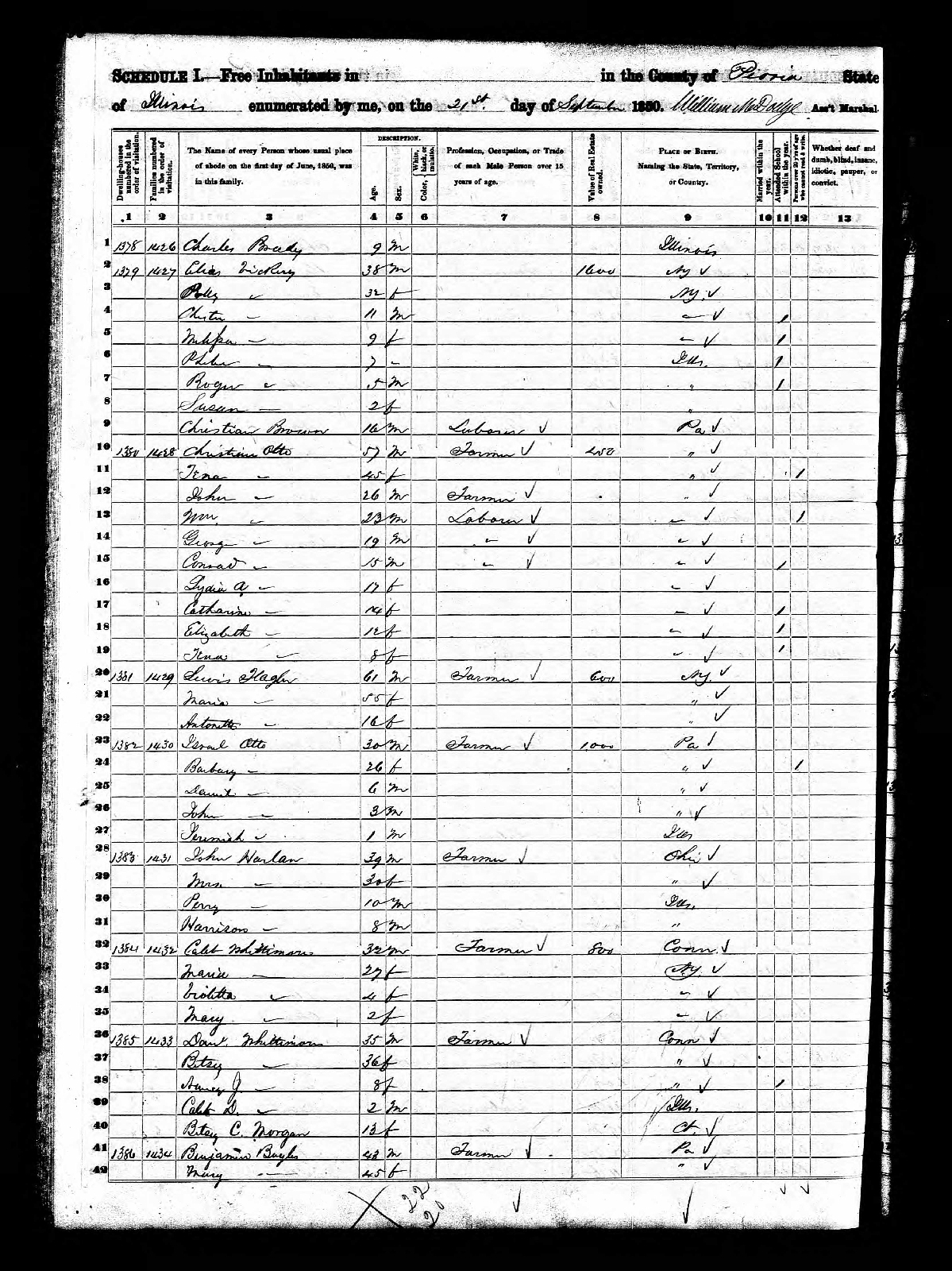
Charles Brady of Kickapoo Township Illinois. Born 1841.

Biography of Charles Brady (1841–1927)

Charles Brady was born in 1841 on the fertile lands of Orange Prairie in Kickapoo Township, Peoria County, Illinois. His parents, John and Ellen Brady, were among the early Irish immigrants who sought better lives in America during the difficult decades before the Great Famine. Growing up amid a community of hard-working Irish Catholic settlers, Charles learned the farming skills and faith traditions that would define his life.

At the age of 21, Charles enlisted in Company G, 67th Illinois Infantry Regiment during the early days of the American Civil War. His unit served primarily at Camp Douglas in Chicago, guarding Confederate prisoners of war — a vital but often overlooked duty that kept him away from the frontlines but deeply involved in the Union war effort.

Returning home after a brief service, Charles married Melissa Ann Dunbar on February 16, 1864, in Peoria County. They built a life together on the family farm at Orange Prairie, raising several children. Over the decades, Charles became a respected farmer, cultivating about 80 acres of rich Illinois soil and contributing to the growth of the Irish Catholic community centered around St. Patrick’s Church.

Charles Brady remained a Democrat and active citizen in local politics, although he never sought public office himself. His quiet leadership helped maintain the tight-knit spirit of Orange Prairie’s farming community through the end of the 19th century and into the dawn of the 20th.

Charles passed away in 1927 at a venerable age, after seeing vast changes sweep across America. He is buried at Oak Hill Cemetery in Peoria, Illinois — a resting place for many of the region’s founding families. Charles’s legacy lives on in the rich soils he farmed, the strong community he helped build, and the descendants who carry his blood and story forward.

There also appears to be a son born out of wedlock found from a PCGS source:

Son: Brady Ralph Waldo Emerson 1872-Apr-16  Father: M Brady, Charles Michael 
Location: 27 Orange Prairie, Kickapoo Twp., Peoria, Ill. Peoria, Peoria Co., IL (Hancock 
St.)
Mother: Pratt, Cunthia Maria 

Timeline of Major Life Events

1841 Born in Orange Prairie, Peoria County, Illinois

1862 Enlisted in Company F, 77th Illinois Infantry Regiment

1862 Mustered out after Civil War service

1864 Married Melissa Ann Dunbar in Peoria County

1870s–1890s Farming and raising a family in Orange Prairie

1927 Died; Buried in  Oak Hill Cemetery, Peoria County
 
Sources Cited

• 1850 and 1860 United States Federal Censuses, Kickapoo Township, Peoria County, Illinois.
• Peoria County Marriage Records, 1867, Peoria County Clerk’s Office, Book C.
• Illinois Civil War Muster and Descriptive Rolls Database, Illinois State Archives.
• 1873 Atlas Map of Peoria County, Illinois.
• Peoria County Genealogical Society.

Charles Brady (1841–1898) – Genealogical Research Archive Additional Information 
 
I. MAP INFORMATION

Resource: 1873 Peoria County Atlas (Kickapoo Township and Orange Prairie Section)
• Area Located: Orange Prairie (near Kickapoo Township) in Peoria County, Illinois.
• Brady Family: Early settlers listed in township records.
• Historical Atlas Reference: Atlas Map of Peoria County, Illinois (1873).
 
II. Service

• Service: Charles Brady served in Company G, 67th Illinois Infantry during the American Civil War.
 
III. GRAVESITE INFORMATION

Burial: Oak Hill, Peoria County, Illinois
• Listing Found: On FindAGrave.com (memorial # 96196257).

 
IV. BIOGRAPHICAL SUMMARY

Basic Life Facts:
• Born: 1841, Orange Prairie, Kickapoo Township, Peoria County, Illinois.
• Parents: John Brady and Ellen,  Irish immigrants arriving by late 1830s.
• Military Service: Enlisted 1862 in Company G, 67th Illinois Infantry.
• Marriage: 16 Feb 1864, to Melissa Ann Dunbar, Peoria County.
• Occupation: Farmer, raising several children.
• Death: 1927; Buried in Oak Hill Cemetery, Peoria County, Illinois.

Expanded Biography:
• John Brady (his father) was among early settlers who helped build St. Patrick's Catholic Church nearby.
• Charles Brady maintained an 80-acre prosperous farm.
• Active participant in local Democratic Party functions but never sought elected office.
• Known as part of the strong Irish Catholic farming community that defined Orange Prairie.
 
V. SOURCES USED FOR ADDITIONAL 

1. 1850 and 1860 United States Federal Censuses — Kickapoo Township, Peoria County, Illinois.
2. Peoria County Marriage Records, 1864 — Peoria County Clerk’s Office, Book C.
3. Illinois Civil War Muster and Descriptive Rolls Database — Illinois State Archives.
4. 1873 Atlas Map of Peoria County, Illinois — Historical Atlas.
5. Peoria County Cemetery Records — Springdale Cemetery, Peoria, IL.
6. History of Peoria County, Illinois (1880s) — Local pioneer biographies.
7. PEORIA COUNTY LATE ENTRY BIRTHS RECORDED 1850-1877 Courtesy of JOHN J.BULGER, County Clerk (1899-1981)

Charles Brady's Pension:
Field Information

Name    Charles Brady
Enlistment Date    2 Jun 1862
Enlistment Rank    Private
Muster Date    13 Jun 1862
Muster Place    Illinois
Muster Company   G

Service Notes: Mustered in Chicago, guarded Confederate POWs, discharged after 100 days.


1. 67th Illinois Infantry Records
• Service: 67th Illinois Infantry was a 100-day regiment, organized in June 1862 and mustered out October 1862.
• Charles Brady served from June 2, 1862 to around October 6, 1862.
• Primary duty: Guarding Confederate prisoners at Camp Douglas, Chicago.
• Meaning: He did not fight in major battles, but served important duty guarding POWs.
Source: Adjutant General’s Report of the State of Illinois, 1862
No battle injuries likely, but he still qualified for veteran benefits later.
 
2. Marriage to Melissa Ann Dunbar – February 16, 1864
• Peoria County Marriage Records, Book C.
 
3. Grave at Oak Hill Cemetery
• Charles M. Brady
• Birth: 1841
• Death: 1927
• Burial: Oak Hill Cemetery, Peoria, Illinois
 
https://www.findagrave.com/memorial/96196257

Family: (https://ancestors.familysearch.org/en/2Z35-H8K/charles-brady-1841-1927)


Charles Brady
1841–1927
Melissa Ann Dunbar
1843–1934
Marriage: 16 February 1864
Edward Brady
1866–1867
Ella Mae Brady
1868–1964
Christina Brady
1870–1954
Ollie Virginia Brady
1872–1955
Mayme Ida Brady
1874–1962
Lena Brady
1876–1877
Thomas F Brady
1877–1961
Albert Brady
1879–1935
Anna Melissa Brady
1880–1930
George W Brady
1882–1971
Addie M. Brady
1884–1959


Sunday, April 28, 2024

Richard Howarth - Kickapoo Township

1902 Kickapoo Township

Richard Howarth, one of the wealthiest residents of Kickapoo, resides on section 30, where he has a large and finely cultivated farm. Not only does the smiling prosperity everywhere visible over the broad extent of his domain bespeak his thrift, prudence, and intelligent adaption of means to secure the desired ends, but the substantial and tasteful buildings of stone which he has erected to accommodate his family and serve the needs of his stock, also proclaim in unmistakable terms that the owner has been no laggard in the "world's great field of battle." He is emphatically a self-made man, and an honor to the county of his adoption.

The parents of our subject, Richard and Martha (Greenwood) Howarth, were both natives of Lancashire, England, where they were married and lived until 1842. They then emigrated to America and settled in Kickapoo Township, in which place they resided until death claimed them for his own. Mr. Howarth was a stone-mason by trade, and followed the business while a resident of his native country, being engaged principally in contracting. After coming to America he commenced farming operations, but when a second harvest had been gathered he fell a victim to the Reaper Death, and passed peacefully away to his home on high, where life is one perpetual harvest of happiness. His wife lingered in this lower world some nine years longer, departing, in 1851, from its cares and pleasures, its sunshine and shadows. They were the parents of fifteen children, of whom the subject of this sketch was one of the younger members.

Richard Howarth, of whom we write, was born April 12, 1824, in Lancashire, England. He accompanied his parents to America in 1842, and remained under the parental roof until his marriage, in 1849, to Miss Alice Lonsdale. Their marriage was celebrated October 25, in Kickapoo Township, amid the festivities usual upon such occasions among the people of that day. With mingled sadness and joy the young couple bade farewell to their respective homes, and took up their abode on a piece of land which forms a portion of the present large farm of our subject.

Mrs. Howarth was a daughter of Thomas and Helen (Halsted) Lonsdale, natives of Lancashire, England. Mr. Lonsdale came to America in 1842, and was joined by his family the following year. They settled in Kickapoo Township, where they resided during the remainder of their earthly pil-primage. Mrs. Howarth was born in Lancashire, England, October 10, 1828, and entered upon the joys of the life beyond January 25, 1887. She was a member of the Presbyterian Church, and throughout her life was an affectionate daughter, a devoted wife and mother, and a true Christian whose death was a severe loss to the entire community, as well as a deep affliction to her immediate friends.

Mr. Howarth is the father of two children, the eldest of whom, Samuel, died when one year old. The second, Martha E., is the wife of William Taylor, and resides with our subject. Mr. and Mrs. Taylor are the parents of six children, as follows: Alice A., Susanna, Richard, Helen, Arthur and Mabel. Arthur departed this life when a tender infant of six months.

Our subject is the possessor of a large farm, comprising some nine hundred acres of land in Kickapoo Township, upon which he resides. He also owns valuable property in the city of Peoria.

Aside from his farming and other interests, he is largely engaged in the mining of coal at Edwards' Station in company with William and James Taylor, and is also engaged with Isaac Wantling in a separate coal mine. They have been very successful in this business, and are amassing wealth with gratifying rapidity. Our subject takes a lively interest in the welfare of his adopted country, and keeps himself abreast of the times by reading and meditating upon the great questions that are presented for consideration from time to time. In politics he is a Republican, and has the good will and admiration of his party friends, but does not make enemies among his political opponents, believing it the inalienable right of everyone to think for himself. [Portrait and biographical album of Peoria County, Illinois; Chicago: Biographical Pub. Co., 1890, pg 763 - Transcribed by: Candi Horton]

From the HISTORIC STRUCTURE REPORT HOWARTH  HOUSE AND BARN WILDLIFE PRAIRIE STATE PARK, PEORIA COUNTY

The Howarth Farmstead was settled by Richard Howarth, Sr. in 1842 and remained under the ownership of his descendents for the next 143 years. The Howarths were one of number of families from Lancashire who settled in close proximity to one another in this area during the 1840s. During this period, Lancashire was the center of Britain’s textile industry and was home to the growing industrial cities of Liverpool and Manchester. Prior to immigrating to the United States, the Howarths had resided in the town of Bacup, which was located on the western slopes of the Pennine Mountains, in eastern Lancashire. Interestingly, there was no direct evidence of them having been engaged in agriculture in their homeland. Richard Howarth, Sr. was a stonemason by trade and had been engaged as a contractor, while his son, Richard, Jr. began his work career as a miner in Lancashire’s coal fields (Johnson and Company 1880:773; Biographical Publishing Company 1890:763). The Howarths’ apparent lack of prior farming experience was a characteristic shared by many of the English immigrants who took up farming in central Peoria County during the middle nineteenth century; a good number of these immigrant farmers had been coal miners in England, while others had been involved in the textile industry and other trades. The Howarth family sailed from Liverpool in February 1842 and finally arrived in Kickapoo Township in September of that year, having come to Illinois via New Orleans and St. Louis (Johnson and Company 1880:773). On July 18, 1842 Richard Howarth had purchased the NW1/4 of Section 30 in Kickapoo Township (Township 9 North, Range 7 East ) for $191.68 (State of Illinois 1984). This quarter section of land contained 153.34 acres and was located in the uplands bordering the Kickapoo Creek Valley. The family’s first home was a sod house, but this was only a temporary arrangement until a more substantial stone residence could be erected. It was during the construction of the stone house, in 1844, that the entire family was stricken with the so-called “Reaper Death,” a sickness that claimed the lives of Richard Howarth, Senior and his son Samuel (Johnson and Company 1880:773). Richard Howarth, Jr. completed the house and subsequently took over management of the farm. Born in Bacup, Lancashire on April 12, 1824, Richard Howarth, Jr. one of fifteen children ultimately born to Richard and Martha (Greenwood) Howarth (Biographical Publishing Company 1890: 763). In the sixty years that separated his father’s death from his own, the younger Richard steadily improved his farm and eventually became one of the wealthiest farmers in Kickapoo Township, owning some 900 acres land, as well as real estate in Peoria. In addition to farming, Howarth also was involved in the local coal industry in Kickapoo Township. He mined coal on his own land until 1867-1868, when he abandoned in the trade in order to devote his full attentions to his farm. In the 1876, however, he would reenter the industry and become a partner in several local mines (Johnson and Company 1880:773; Biographical Publishing Company 1890:764). This juggling of mining and agriculture was a common practice among English immigrants. In 1849, Howarth married Alice Lonsdale, who also was a Lancashire native. Alice’s father, Thomas Lonsdale, came to the United States in 1842. The following year, the rest of his family emigrated from England, and they made their home in Kickapoo Township. Richard and Alice Howarth had only two children: Samuel, who died when he was only one year old, and Martha Ellen, who was born in December of 1851 (Biographical Publishing Company 1890:763; USBC Population Schedule 1900:122A). Richard Howarth, Jr. is listed in the 1850 census of Peoria County as a 25-year old miner who had been born in England. Other inhabitants of the Howarth household in 1850 included Richard’s wife Alice (age 22), his 66-year old mother, and two other tenants. The tenants were David Bond, an 18-year old laborer, and Jacob Waalslen, a 25-year old miner. All of the members of the household were from England. No values of personal property were recorded in the 1850 census of Peoria County, but Howarth’s real estate value was recorded as $2,000, indicating that some improvements had been made to the land (USBC1850b:138). Even though Richard Howarth was reported as “miner” in the 1850 census he also was engaged in farming. His farm was listed in the 1850 United States Agricultural Census with a value of $2,000, while his farm implements and machinery listed as being worth $100. Only 50 of Howarth’s 200 acres were improved. The value of his livestock was $215, for he owned only four horses, three “milch” cows, two other cattle, and twelve pigs. He had produced 150 bushels of wheat, 500 bushels of Indian corn, and 200 bushels of oats (USBC 1850a: 267). Howarth significantly expanded his land holdings over the course of the next decade. On June 2, 1851, he purchased 160 acres in the SE ¼ of Section 30 from Alfred G. and Antoinette Curtenius, John and Elizabeth Griswold, and Matthew and Charlotte Griswold, all residents of Peoria County, for $550 (Peoria County Deed Record 2: 144). He purchased an additional 160 acres in the NE ¼ of Section 30, T9, R7W on May 16, 1855 from Eliza Eadon, Eliza Crawley, and Marianne Eadon, of Peoria County, for which he paid $1,800 (Peoria County Deed Record MA:635). In the 1860 census of Kickapoo Township, Peoria County, Richard Howarth was reported as a farmer, with real estate now valued at $11,200 and personal property worth $3,000. Since the last census was taken, his mother had passed away and his wife had given birth to Martha Ellen, who was born in Illinois, eight years before. The Howarths also had three farmhands and one servant residing with them, all from England (USBC 1860b:120). The Howarth residence and barn appear on the 1861 land ownership map of Peoria County. The map also indicates that Howarth owned the northern two-thirds of Section 30 by this date (Allen 1861). The 1860 agricultural schedule listed the cash value of Howarth’s farm as $6,000, the value of farm implements and machinery as $500, and 150 acres as improved. While Howarth owned several animals and grew different produce, his biggest crop was Indian corn, of which he produced 2,000 bushels. Other produce included rye, 160 bushels; oats, 300 bushels; wheat, 350 bushels; peas and beans, 300 bushels; buckwheat, 20 bushels; hay, 20 tons; Irish potatoes, 300 bushels; and grass seeds, 15 bushels. The total value of orchard produce was $20. For livestock, Howarth owned twenty heads of cattle, twelve pigs, nine horses, and eight “milch” cows. The value of livestock was listed as $1525; the value of animals slaughtered was $200 (USBC 1860a:1).

The 1870 population census shows that Howarth’s real estate property had increased in value over the preceding decade to $20,000, while his personal property had decreased to $2,000. His household in 1870 consisted of himself, his wife, and daughter, in addition to two farmhands and one “domestic.” In contrast to their hired help a decade before, the domestic and farmhands employed by the Howarths in 1870 had all been born in Illinois (USBC 1870b:15). The agricultural schedule of 1870 indicates that Richard Howarth’s real estate had expanded to include to 300 acres of improved land and 300 acres of woodland. Despite the increase in tillable acreage, the schedule reports a decrease in the amount of produce Howarth turned out. He had more livestock than in 1860, although it was less valuable at only $1,220. He also had slaughtered $1,000 worth of livestock, substantially more than what was recorded in the 1860 schedule. The estimated value of Howarth’s farm production was $2,000 (USBC 1870a:3). On February 24, 1872, Richard Howarth purchased the N1/2, SE1/4 of Section 30 from his neighbor, James Greenough. That same day, Greenough purchased the S1/2, SE1/4 of Section 30 from Howarth. The Greenoughs later sold that parcel of land to Jonathon Howarth, Richard’s brother (Peoria County Deed Book ZD:11). An 1873 atlas of Peoria County includes a map of Kickapoo Township, which illustrates Richard Howarth’s own residence and three other houses (presumably tenant-occupied) on his land holdings. An orchard is depicted lying south of the Howarth House. The map suggests that Howarth had improved a large portion of the 300 acres that were recorded as woodland in 1870. Coal measures are shown on his land, as well as adjacent properties to the south and west of his. The 1873 atlas also includes a lithograph of the Howarth’s Farmstead, which illustrates the residence there and impressive stone barn (Andreas 1873:128, 135137). On April 12, 1876 Martha Howarth married William Taylor, who had emigrated from England only three years before (Bateman and Selby 1902:728). Rather than establishing a separate household, the couple lived at the Howarth Farmstead with Martha’s parents. The 1880 census lists William and Martha Taylor (ages 24 and 28, respectively) residing with Richard and Alice Howarth, along with their two young daughters, Alice (age 3) and Susanna (age 3 mo.). Other occupants of the Howarth household at this time included a domestic servant, from Virginia, and two farm hands, from England and Kentucky (USBC 1880b:27). The value of Howarth’s farm, including land, fences, and buildings, was reported in the 1880 agricultural schedule as $18,000. Only two other farms in Kickapoo Township were valued higher than Howarth’s, and two others had an equal value to his. Howarth, however, actually owned more land than any other farmer in the township (Agricultural Schedule 1880: 117). At this time, 500 acres of his land were improved, while the remaining 100 acres were woodland and forest. His farming implements and machinery were valued at $300, and his livestock was worth $3350. The estimated value for all farm products for the past year was $2,000. Howarth had increased his livestock holdings considerably since 1870. He now owned 100 head of cattle and 7 “milch” cows, 110 swine, and 70 poultry (presumably chickens). His cattle and swine were the largest herds in the township. Indian corn was the principal crop grown on the farm, with 4,000 bushels produced on 100 acres. Oats, rye, potatoes, and apples also were grown (USBC 1880a: 14).

In addition to farming, Richard Howarth also mined coal on his land. The extent of his early mining operations are not known, since he is not listed as a coal operator in either the 1850 or 1860 Industrial Schedules of Peoria County. Yet, he reported his occupation as “miner” in 1850, at the very time that the first extensive coal operations in the county were starting up in around Hale’s Mill (later Pottstown). He possibly worked the coal measures the 1873 atlas of Peoria County illustrates on his land on the NE¼ of Section 30, south of Kickapoo Creek (Andreas 1873:127). Howarth retired from mining in 1867-1868, but he reentered the field in 1876, in partnership with William Taylor, his son-inlaw. Taylor, like Howarth, was a native of Lancashire, and one wonders if he too might have worked in the coal fields of that region prior to emigrating in 1873 (Johnson and Company 1880:773; Biographical Publishing Company 1890:764; Bateman and Selby 728). In 1882 Richard Howarth also established a coal-mining partnership with Isaac Wantling. Their copartnership agreement stated that the men intended to open a mine (or mines) on Howarth’s lands in Section 30 of Kickapoo Township. Howarth relinquished his coal rights on Section 30 to the partnership, and also agreed to give land in Section 19 for the construction of a grocery store, tenant house and other buildings that might be necessary for the operation of the mine. In consideration for providing the coal, the right-of-way, and the land to the business, Howarth was to receive six cents per each ton of coal mined, beginning after December 1, 1885. Profits above this royalty were to be shared equally, and the two men also agreed to split the costs of establishing and operating the mine. Another stipulation of the agreement allowed Howarth to substitute William Taylor for himself as partner in the firm (Peoria County Deed Record MG: 126-127). In a 1902 biography Taylor emphasizes his long-term involvement in mining coal on the Howarth Farm (Bateman and Selby 1902:728), and it is possible that he oversaw day-to-day operations of the mines, while his father-in-law devoted the bulk of his attentions to farming. The 1891 coal report for Peoria County lists seven mines operating at, or in the vicinity of Edwards Station, all of which were drift mines. The largest of these mines was operated by “Howarth and Taylor Brothers” (a firm comprised of Richard Howarth, William Taylor, and James Taylor), which employed thirty miners on average and had extracted 13,600 tons of coal for the year. This mine was one of two at Edwards Station that functioned as a shipping mine (presumably serving the Peoria market), and it was the only one that employed steam power; the other mines being either horse or hand powered. The coal report makes no mention of “Wantling and Howarth” (the name proposed in the co-partnership agreement) at Edwards Station (State Bureau of Labor Statistics 1891:120-121). An 1890 biography of Howarth, however, specifically states that he was “engaged with Isaac Wantling in a separate coal mine” (Biographical Publishing Company 1890:764). This suggests that the partnership between the men either had dissolved or was operating under a different title by this date.

In the 1900 census, Richard Howarth’s son-in-law, William Taylor, was listed as the head of the family household. Howarth himself was a widower by this date, his wife Alice having died in 1887. William and Martha Taylor’s six surviving children—Alice (age 22), Susannah (age 20), James (age 18), Ella (age 16), Mabel (age 10), and Walter (age 5)—were still residing at home in 1900. Despite his active involvement in coal mining, Taylor reported his occupation as “farmer” in the census. Richard Howarth was retired, but he retained ownership of the family farm; in the census, he was reported as a landowner, and Taylor as a renter (USBC 1900:122A; Biographical Publishing Company 1891:763-764). An 1896 plat map of Kickapoo Township illustrates the landholdings associated with Richard Howarth’s home farm during this period. Howarth also owned land on Sections 21 and 27, several miles to the east of his residence (George Ogle and Company 1896). His combined real estate holdings in Kickapoo Township during this period came to some 900 acres of land (Biographical Publishing Company 1890:764). A lithograph portrait of Howarth, was drawn late in his life. Richard Howarth died on February 3, 1904. In his Last Will and Testament, he left all of his real estate to his daughter Martha, except for those lands he previously had conveyed to her children (through deeds held in escrow). The will indicated that he deeded 240 acres to his oldest granddaughter, Alice Conley. The monies received by his heirs was as follows: Alice R. Conley, $1,000; Susannah Taylor, $7,900; Ella Taylor, $4,900; James Richard Taylor, $4,900; Martha Ellen Taylor, guardian of Mabel Ellen Taylor, $9,400; and Martha Ellen Taylor, guardian of Walter William Taylor, $16,400. Martha, acting as Walter’s guardian, was given the option of keeping his money in interest until he was of age or to use the money to purchase a farm for him at any time before he reaches a lawful age. Howarth also left $500 to the Episcopal Church of North Limestone (Christ Episcopal Church), of which he was a long-time member. He was buried in that church’s graveyard, next to his wife Alice, whose death had preceded his own by some twenty years. Howarth’s estate paid out a total of $45,359.91 to his debtors and heirs. No real estate or chattel was listed in the inventory of Howarth’s personal estate, due to the fact that he deeded all of his property to his daughter prior to his death (Peoria County Estate Record No. 6374). On July 15, 1903, Richard Howarth had deeded the following property in Kickapoo Township to his daughter: The NW¼ of Section 30, totaling 153 acres; NE¼ of Section 30; the NE¼, SW ¼ of Section 30; so much of the W½, SE¼ and the E½, SW¼of Section 19, as lies south of the center line of the main track of the Chicago, Burlington, and Quincy Railway; and the S½, SW¼ of Section 19, containing 160.46 acres. He also deeded her Lot 11 of Adam’s Addition to the City of Peoria, and Lots 3 and 4 in Kellog Place (laid out in part on Lot 4 and in part of the reservation in Ashael Hale’s Addition to the City of Peoria). The transaction was not recorded until February 8, 1904, four days after Richard’s death (Peoria County Deed Record VI:490, roll D-192). Martha Ellen Taylor is designated as the owner of the Howarth Farmstead on a 1904 Peoria County map (Hendrickson and Richardson 1904). Martha and William Taylor continued to reside in the Howarth House after her father’s death, and the couple is believed to be responsible for the construction of the circa 1910 wing on the west end of the dwelling. 

Sources: 

https://genealogytrails.com/ill/peoria/bio/biosH2.html

https://archive.org/details/portraitbiographi00biog/page/763/mode/1up

https://libcat.familysearch.org/Record/2306207?searchId=462923&recordIndex=4&page=1&referred=resultIndex

https://www.familysearch.org/library/books/records/item/507861-standard-atlas-of-peoria-city-and-county-illinois-including-a-plat-book-of-the-villages-cities-and-townships-of-the-county

http://illinoisarchaeology.com/IDNR/Wildlife

https://www.findagrave.com/memorial/85987346/richard-howarth

Gilbert Marion Heinz of Kickapoo Township

Gilbert Marion Heinz was born on May 17, 1924, in Kickapoo, Peoria County, Illinois, the fourth child of Alex P. and Rosella V. (Gilles) Hei...