Saturday, March 18, 2023

AL FRESCO AMUSEMENT PARK, PEORIA HEIGHTS, ILLINOIS 1905-1944

Al Fresco Amusement Park, Peoria Heights, IL (1905-1944)

In 1904, a man from Chicago by the name of Vernon Seaver made his way into Central Illinois with a plan. Seaver, president of the Trans-Continental Amusement Company, wanted to provide Peoria with a trolley park. The entrepreneur had constructed White City Park in Chicago and was prepared to model the Peoria park after it. He allegedly anchored his yacht at the foot of Main Street in the Illinois River and searched the area for the ideal location for his creation.

The area Seaver landed on was in Peoria Heights, off Galena Road, adjacent to the Illinois River. Thomas Webb, a prominent Peoria diamond jeweler, owned the land, and agreed to participate in Seaver's project. All Seaver needed now was financial assistance. Luckily, John Finley, head of the Central City Streetcar Company, backed funding for the park. Finley's assistance didn't come merely from the kindness of his heart; he figured that the amusement park would bring enormous amounts of business to the streetcar company during the summer months. As the future popularity of the park would show, he was correct.

Construction of the park began immediately. Seaver obtained the services of the Ingersoll Amusement Company to build many of the park's main attractions, including a 65 foot-high Ferris wheel and a figure-8 roller coaster. Most of the rides contained within the park were the first of their kind in Central Illinois. Not all the rides and attractions were built from scratch; the 1904 St. Louis World's Fair provided statues, benches and lights to the park.

Word quickly spread of the park's construction and residents of Central Illinois eagerly anticipated the opening of their newest attraction. Seaver named his park Al Fresco, meaning "Open Air", and in a March of 1904 an article of the "Journal Star" declared it be a "summer resort free from all vulgarity, where families can go and have innocent enjoyment."

The article's anonymous author sang Seaver's praises, stating that "such a place has been a long felt want in Peoria and it seems a wonder that in a prosperous city like Peoria, no one has been enterprising enough to inaugurate a place like this."

A short article on June 9, 1905, announced Al Fresco's opening for the following day:

The completed Al Fresco Amusement Park deserved such declaration. It truly was a marvel. Besides the Ferris Wheel and figure-8 roller coaster, Al Fresco's also featured a number of games and other frivolities. Many attractions to the park could be considered dangerous by today's standards. High wire and high diving acts were quite common, and diving horse acts and motorcycle jumping acts also afforded a dangerous pleasure. Perhaps the most incendiary of Al Fresco's performances was what was called the "slide for life." In this act, a wire was attached to the top of the circle swing ride and stretched to a point on the river. A man was doused with kerosine, set afire, and before he burned himself alive, slid down the wire into the Illinois River.

Also in the park was a two-story pavilion called the Japanese Garden. The second floor featured a movie house that frequently screened films by Charlie Chaplin, while the ground floor housed a pavilion and beer garden. This area hosted a number of vaudeville acts and other performances. Some of the famous faces to grace the stage were escape artist Harry Houdini and boxers John L. Sullivan and Jim Corbett. Frequent performers included bands and orchestras, Buffalo Bill's Wild West Show, and the Cherry Sisters, a three-person singing act. The Cherry Sisters hailed from Iowa, where their father was forced to mortgage his farm. The sisters formed their singing team to help him. They were by far the most popular act, despite the fact that they sang so badly audiences would throw things at them, forcing them to perform from behind a screen.

Another important draw to Al Fresco was Dewey Beach, which allowed visitors the opportunities to swim and fish. Two bath houses lined the beach, where bathing suits could be rented for 10-25 cents. Fishing boats were also available. Al Fresco's boat dock contained a popular barge decorated to resemble a battleship.

Admission to the park was 10¢ for adults and 5¢ for children. In the summers between 1905 and 1927 nearly 10,000 people visited the park daily. Vacationers poured in from all around the Midwest, most of them traveling by ship from St. Louis and Chicago. Locals flooded the park as well, and arrived there by various modes of transportation. Many came by streetcar, while others simply parked on Grandview Drive and walked their way to the park via Gibson Pathway. Those who could afford it took steamboat rides from downtown Peoria.

One 1918 steamboat ride in particular ended in tragedy. As the Columbia brought passengers back downtown after a day's fun at Al Fresco, a hole was torn in the hull, sinking the boat and claiming the lives of 87 of the 500 passengers aboard. A memorial was dedicated to the victims in 2003.

For most of the twenty-odd years that Al Fresco was in business, however, it maintained the air of innocent fun that Seaver had anticipated. The park and its attractions flourished until the late 20s. Attendance rates began to drop during World War I, but natural causes would ultimately result in the death of the park. During the 20s, the Illinois River, raised by Chicago drainage, permanently flooded portions of the park. Several rides were damaged by this flooding and were never repaired. The dismantling of the famous figure-8 roller coaster in 1928 marked the end of Al Fresco Amusement Park as it was formerly known.

In 1929 the land was leased to Fred C. Feyler, who rented the area out to traveling circuses. Swimmers and picnickers still flocked to the area until World War II. Due to an enormous drop in attendance rates, Feyler declared that all men in uniform would be admitted for free. However, Feyler did not anticipate the number of soldiers that were stationed at nearby Camp Ellis. After his announcement, hundreds of men flocked to the once-popular amusement site. The park was forced to officially close in 1944.

Today, Al Fresco's address is 4602 N. Galena Road. Occupying the land where thousands of vacationers once frolicked is a trailer park and a private club. The Illinois River is no longer as clean and scenic as it used to be. Though times have changed and the Al Fresco Amusement Park is largely forgotten, the delight and diversion it once brought during its short existence is definitely something to remember this summer.

https://drloihjournal.blogspot.com/2018/11/al-fresco-amusement-park-peoria-heights-illinois1905-1944.html?m=1


Wednesday, March 1, 2023

Max Heinz (b1872) of Kickapoo Township

If not for Max Heinz, there would have never been a "Heinz Family: 1810 - 1975, by Mrs. Wm. L. Heinz and Robert D. Heinz " book published in 1975, or any of the research many of us have been able to conduct and publish over these last few years. While he stopped in 1948, the legacy continues. He could have never imagined how he, and his work, was going to be in full digital and end up far beyond his wildest dreams @ https://ejheinz.center/GedSite/EJ-o/g1/p17.htm#i412


"Max Joseph Heinz never married. He stayed at home on the farm until he was 25 years old, then rented land and went into farming for himself. In two years, he went broke. First the land was too wet, and later it was too dry. There was no crop and no grain prices to pay expenses. Later he did carpenter work and paper hanging.

In 1930 Mr. Heinz moved to Dalhart, Texas. In 1931 he borrowed the money to go into farming and went broke again because of the depression. Then he worked on the W.P.A. until he was 65 years of age, when he was taken off that. He then received Old Age Assistance.

In 1941 he moved to San Angelo, Texas, on account of his high blood pressure. There he lived the rest of his life.

Mr. Heinz undertook the task of writing a Heinz Historical Book. It is that book which provided the inspiration for the compiling of the Heinz Family History; by Mrs. William L. Heinz, Genealogy book. Mr. Heinz gathered facts and dates at family reunions and other social gatherings. If he had not pursued that interesting hobby, most of the early information contained in the book would have been lost from memory and gone forever! He continued the book until 1948."


Saturday, February 11, 2023

THE GEORGE HEINZ SR. (b. 1813) FAMILY OF KICKAPOO TOWNSHIP

Ancestors of this large family were John Henry Heinz and Eva Catharine Ester, his wife, of Nausdorf, Hesse Cassel, Germany. They never came to America and lived in Darmstadt in the state of Hessen, Germany that was also part of Napoleon's Confederation of the Rhine.


George Heinz, Sr. (b. March 28th, 1813, d. March 29th, 1891) was the second child of this family and had five siblings; Annie Margaret Hoffman Berckler, John Henry Heinz (stayed in Germany), Andrew W Heinz, Wendell Heinz, and Fredrich S Heinz. He was baptized on March 28th, 1813. He married 25 year old Katherine Henlein, (b. July 20th, 1813, d. October 29th, 1895) on April 7, 1839 in a catholic church in Dietersheim, Germany in 1838.

George Heinz Sr. and Katherine (Henlein) Heinz were among the first pioneers who came to America. They left Germany in 1839, crossing the ocean in a sailing ship. The voyage lasted ninety days. They landed at Baltimore, Maryland on August 5, 1839. They came through the St. Lawrence River to Chicago, and then down the Illinois River with a tow boat drawn from a long rope by a mule and oxen, and landed at what is now Peoria, IL.

George worked for a while for Captain Moss at a point near Rome, IL. The first year George and Katherine received $5.00 in money, with both of them working every day and boarding themselves. The second year both worked every day and boarded themselves and received as payment one cow and no money. After working a few years for Captain Moss, George farmed the Bradley farm on the West bluff in the city of Peoria for a few years. This was just opposite Main Street.

Later, George purchased 160 acres of land on Section 16 in Kickapoo Township (now Cramer's as of 1975). He cleared the land for farming and built a log cabin. Later he made his own bricks and lime and built a handsome brick house (The farm is now owned by Martin Gensler as of 1975). All of their furniture was hand made. All of their cloth for clothes were hand spun. Georges first plow was a wooden moldboard that cut a width of 20 inches and was drawn by oxen. His first wagon was hewn out of logs and not a nail of iron was used in making the wagon. The wheels were sawed out of a log about three feet across and 8 or 10 inches wide. He drilled the hole for the axle in the wheel with a stone and for axle grease used soap. The pioneer farmers drove these wagons to Chicago and back with grain or dressed hogs to get money, since Peoria was only a trading post then. It took six weeks to make one trip to Chicago and back. There were twelve wagons which were called trains, and each wagon was hitched by a yoke of oxen. At the end of one journey only one wagon remained because all the rest were worn out and several of the oxen perished on the way since there were no roads and only trails with no bridges to cross the streams. For lamps, a tin pan with grease or tallow, and a rag or some kind of cord sticking out at one end as a wick, served the purpose. There were no stoves for cooking, baking, or heating, only the open fireplace.

In 1855 Mr. George Heinz donated a small tract of land for school purposes, located in Kickapoo Township and formerly called District 58. A schoolhouse was built the same year, being occupied until 1904 when the directors thought the building inadequate to accommodate the children attending and proceeded to erect a new building on section 16 in Kickapoo township. No deed for the ground had ever been obtained from Mr. Heinz, therefore the directors refused to build it until it was granted. A deed was finally secured from Andrew Heinz, son of George Heinz Sr.

The contract for the new school was let to J.S. Foster of Peoria in 1904, to be completed for the sum of $850.00. The building was finished and ready for occupancy the same year.

This school is still standing on Heinz Lane after the interstate 74 overpass on the left off of Route 150.

George Heinz Sr. owned 360 acres of fertile land which was divided among his 5 sons after his death. He was paralyzed for the last ten years of his life.

To the union of John Henry Heinz and Eva Catharine Ester were born five sons and one daughter:

1. George Heinz Sr., born Mar. 28, 1813, died Mar. 19, 1891, had five sons; Henry, born Sept. 26, 1840, died Aug. 22, 1881, Frank, born Oct. 19, 1842, died Oct. 22, 1922, George, born March 10, 1845, Andrew, born Sept. 25, 1847, and John, born Dec. 30, 1849.

2. John Henry Heinz was born on 21 Oct 1815 in Hesse, Darmstadt, Germany. He died in 1910 in Germany. He married Katherine Margaretha Schneider on Aug. 30, 1846 in Hesse-Darmstadt.

3. Andrew Heinz, Sr., born Feb. 16, 1823, landed at New York in 1848, and came to Peoria by way of the lakes to Chicago and the Illinois River. He worked for his brother George, also in brickyard, cut wood and hauled it to Peoria for 75c a load, and also worked for C. B. & Q. railroad. Married Christina Reed in Kickapoo Township, who was also a native of Germany, a daughter of Morris Reed. There were seven children of this marriage: Fred, Henry, Andrew, George, Katie, Anna, and Theresa.

4. Frederick Heinz, Sr., born May 19, 1827, landed in America 1848, and came direct to Kickapoo Township, where he joined his brother George. He married Eva Seibert from Hesse Darmstadt, Germany, who had come to America alone to live with her sister in Kickapoo Township. She died July 6, 1894. Mr. Heinz first purchased 80 acres of land, mostly timber, on Sec. 16, for $500. He cleared off the timber and built a log cabin, which was later replaced with a brick house. Mr. Heinz at different times served as Supervisor, Road Commissioner and School Treasurer of his Township. One child was born of this union, Anna M., who married John Brutcher.

5. Wendel Heinz, landed in America 1848, worked for his brother George. He had team of horses, harness and wagon; then went to St. Louis to get some more things, but never returned and no word ever heard from him.

6. Anna Margaret Heinz, born May 1, 1810, died March 11, 1895; married William Berckler, first husband, of Hesse Darmstadt, Germany, who was born in 1797; married Nicholas Hoffman, second husband, of Scharchbach, Germany, who was born Jan. 1, 1800 and died Nov. 30, 1868. Landed in America July 3, 1853, and to this union were born five children: John Hoffman, Maroa, Illinois; Nicholas Hoffman, Pottstown, Illinois; Peter Hoff-man, Iowa; Fred Hoffman, Maroa, Illinois; Eva Hoffman Laszell, Maroa, Illinois.

The history of the Heinz family has been the history of Kickapoo Township.

Authored by E.j. Heinz in 2023 with sources listed.

Sources:

Material Furnished by Max J. Heinz, 1928

HISTORY AND REMINISCENCES - Old Settlers' Union of Princeville and Vicinity Vol. 4, 1929

Heinz Family History 1810-1975

https://ejheinz.center/GedSite/EJ-o/up/index.htm


Tuesday, February 7, 2023

Nicholas G. Heinz. A product of the agricultural regions of Peoria County

1933


Nicholas G. Heinz comes from a family of farmers and was himself intended for that vocation, but in his young manhood decided upon the trade of carpentry instead and for many years has been engaged therein at Kickapoo, where a number of residences and other structures bear evidence to his skill and good workmanship. He has never been a seeker after public office, but has always been a good citizen, and has won and held the respect and good will of his fellow-men. Mr. Heinz was born on the home farm in Kickapoo Township, Peoria County, in 1884 and is a son of George and Fredericka (German) Heinz, and a grandson of George and Catherine Heinz. The grandfather was born March 30, 1813, in Hesse-Darmstadt, Germany, where he received his education in Catholic schools, and was a young man when he made his way to the United States in search of his fortune. Landing at Baltimore, he came directly to Peoria, where he soon found employment by the day as a farm hand, but was industrious, enterprising and ambitious, and soon saved enough to start operations of his own in Kickapoo Township, where he took up land. Mr. Heinz eventually became one of the substantial men of his community and had the respect and esteem of his fellow-citizens. George Heinz, son of the pioneer was born at Mossville, Illinois, in which locality he attended the country school, and during all of his school period gave his leisure time to his father, in assisting in the development and cultivation of the home place. Born in 1845, he reached the ripe old age of more than eighty years, passing away in January, 1926, when he was accounted one of the well-to-do men of the county. He and his wife were the parents of seven children: Gertrude, Maximilian, Margaret, Charles, Nicholas G., Rose and Alexander. Nicholas G. Heinz attended school in the vicinity of the home farm, on which he worked until entering upon his individual career. His boyhood was crowded with hard and unremitting labor, and he had little liking for the tasks of the farm, so when it came time for him to make a choice he applied himself to a mastery of the carpenter's trade, which he learned with his brother. He has made a success both as a general carpenter and in addition has done some contracting and is known as a master of his vocation and as a man who lives fully up to the letter of his contracts. Mr. Heinz is unmarried and makes his home with his brother. He belongs to the Carpenters' Union at Peoria, and as a German Catholic holds membership in the Catholic Church at Kickapoo and in the Knights of Columbus,
in which fraternity he has numerous friends.

The transcription was taken from "Illinois: the heart of a nation" Volume 3.
-------------------------------

1975

Nicholas George Heinz was born May 29, 1884. He was the 9th child of George Heinz II and Fredricka (German) Heinz. He was of Catholic faith. He never married.

In his early years he worked on the farm at home. Then he bought the Silverleaf Pavilion, two miles east of Kickapoo, Illinois, in partnership with Emil Heinz. Later he bought out Emil’s share. Nick operated Silverleaf for several years, holding dances every two weeks and lots of parties. The annual Heinz Reunion was held there, starting in 1924. The building is no longer in existence.

Mr. Heinz worked for his brother Felix for awhile. He worked at Keystone Steel and Wire Co. for several years. He joined the Carpenter's Union #183 and was employed in that line of work until his death on Aug. 15, 1953.

Sources:

Quoted from The Heinz Family History, by Mrs. William L. Heinz, page 77.

http://www.peoriacountyillinois.info/bios/heinz%20nicholas%20g.html


Sunday, January 22, 2023

George Heinz II (b1845) Kickapoo Township

George Heinz, who owned the farm, was a prosperous farmer and invented the first potato planter and the first potato bug catcher. He raised many potatoes in his early farming and raised and fed many hogs each year. He was a church director for several terms and a staunch Democrat all his life. He was the Township road maintenance overseer for many years. He was also Township Commissioner for two terms. He put the first gravel on the highway in Illinois for a pavement. Then came the State gravel road, then the State concrete road. His first drain on his land was four boards nailed in a square to drain off surplus water on his land. The box-like drain was laid underground so he could farm over it. It was successful.

George Heinz owned 1,410 acres of land at his death.


Thursday, June 9, 2022

Peoria Disposal Company

Peoria Disposal Company (PDC) was founded by John Coulter in 1923. By 1980, PDC had grown from a one-man garbage collection operation into a large solid waste disposal company. In 1983, John Coulter’s grandson Royal Coulter became the third generation of Coulters to lead the company. Under Royal’s guidance, PDC realized rapid growth with the acquisition of AREA Disposal Service. From 1987 to 1992, PDC acquired nearly 30 companies located in central Illinois consisting of four landfills, 200 trucks, 100 pieces of heavy construction equipment, a non-hazardous liquid waste treatment plant, four recycling and processing centers, and one RCRA hazardous waste stabilization facility. By 2012, the company had evolved into Coulter Companies, Inc. composed of 17 different companies with over 500 employees.

A 1934 Heavy Duty Ford Pickup truck now welcomes employees and visitors as they drive into the PDC Transportation facility on Swords Avenue in West Peoria.  Company President Royal Coulter is using the classic work truck to honor his grandfather when PDC was established in 1928.  A small building was constructed with massive windows to protect the vehicle.


Friday, February 4, 2022

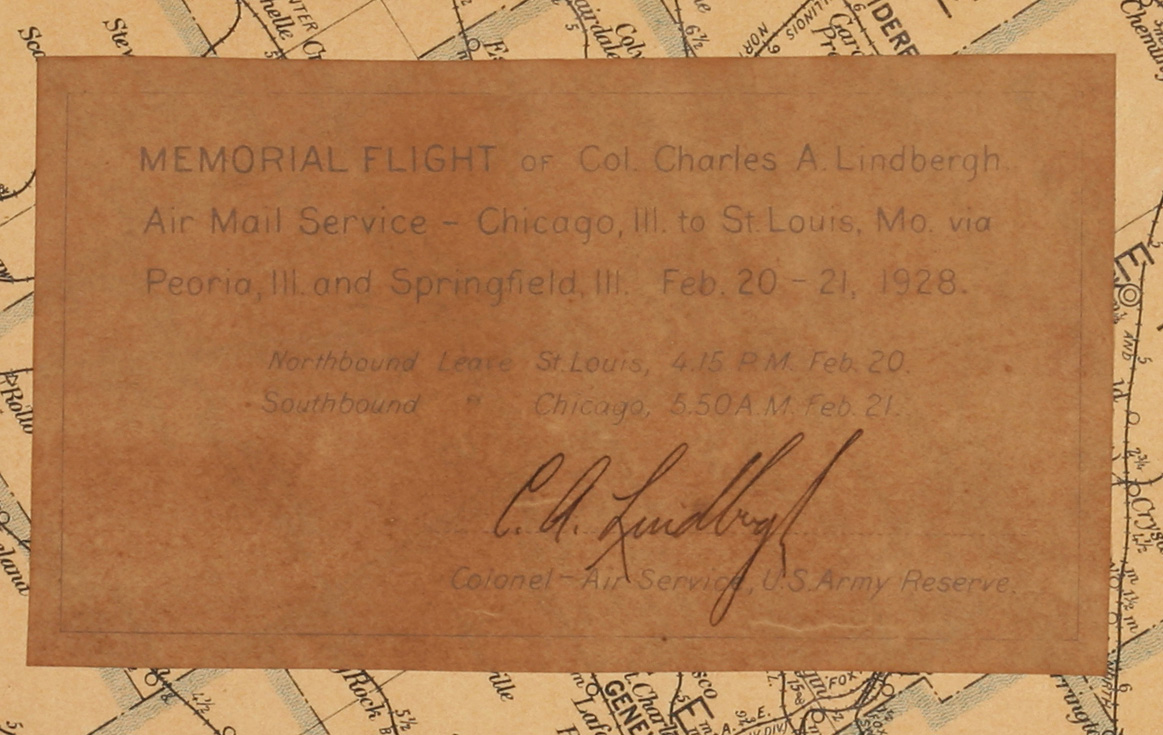
Charles Lindbergh, the 24-year-old barnstormer hired by the Robertson Aircraft Company to lay out and fly the newly organized Contact Air Mail Route #2 with a stop in Peoria

In 1925, Congress passed the Kelly Act, which authorized the Post Office to contract with commercial air carriers to create and maintain new airmail routes. The first two Contract Air Mail Routes were inaugurated on Feb. 15, 1926. One ran between Detroit and Cleveland, the other ran between Detroit and Chicago. 

Charles Lindbergh was a 24-year-old barnstormer and flight instructor living in St. Louis when he was hired by the Robertson Aircraft Company to lay out and fly the newly organized Contact Air Mail Route #2. This route, only the third commercial airmail line in the country, would provide airmail service between Chicago and St. Louis, with stops in Springfield and Peoria.

Robertson Aircraft Corporation won the Chicago-St. Louis air mail route (CAM-2) which included stops at Peoria and Springfield. It began on April 15, 1926. One of its pilots was none other than aviation pioneer Charles A. Lindbergh.

Robertson Aircraft used two DeHavilland DH-4′s to operate the route. The first flight departed St. Louis, stopped in Springfield and then at 6:55am, Lindbergh touched down at Kellar Field. Two planes flew together and the second of these landed just behind Lindbergh. Harlan Gurney, Phillip Love and Thomas Nelson were the other pilots assigned to this route.

Daily flights went smoothly until April 22 when Love smacked his undercarriage on a drainage ditch at the west side of Kellar Field. The propeller and belly of the DH-4 suffered damage so a spare plane was flown up from St. Louis by Nelson. This wasn't Peoria’s first aviation accident, but the first involving a scheduled flight.

The government had introduced sketchy airmail service in 1918 and had extended it coast to coast by 1920. By 1925 the service had added a number of feeder routes. A total of nine such routes crisscrossed the country. Brothers William and Frank Robertson (World War I pilots) from St.Louis operated C.A.M. #2, a government contract airmail route between St Louis (STL) and Chicago by way of Springfield (SPI) and Peoria (PIA). (278 mile route, five round trips a week, beginning on April 15,1926). The government paid by the pounds of mail carried, often the sacks weighed more than the mail inside. Robertson was one of a few aircraft companies to carry mail only. Most also carried passengers to offset costs.

On september 16,1926, in Aircraft #112 Lindbergh departed STL at 4:25pm arriving in Springfield at 5:10pm. After picking up additional mail, Lindy departed for PIA landing at 5:55pm. At 6:10pm Lindy started the PIA to Chicago leg. There was a light ground haze with partly cloudy skies. Darkness came at approximately 25 miles northeast of PIA. A low fog rolled in a few miles northeast of Marseilles, Illinois at the Illinois River. Fog extended upward to 600 feet and Lindy was unable to fly under it. Flying northeast until 7:15pm, a glow on top of the fog indicated a town below near Chicago (Maywood). After circling for thirty-five minutes with no luck in finding the field, Lindbergh headed west to clear Lake Michigan. Flying westerly for fifteen minutes then turning southwest, Lindbergh was hoping to find the edge of the fog bank at the Illinois River. To Lindy's surprise, the engine started to sputter. "I thought the carburetor jets were clogged. There should be plenty of fuel remaining in my main fuel tank. I followed my emergency procedure and switched to my reserve tank." The engine came back to life immediately. " The main tank must be dry." At 8:20pm the main fuel tank was indeed dry and Lindbergh was left with only the reserve fuel. Unable to find a break in the fog, Lindbergh was forced to make his third emergency parachute jump. (From an altitude of 5000 feet) When the engine sputtered and died, Lindbergh jumped out of the right side pulling his ripcord after falling about 100 feet. The Irving Parachute (seat type) functioned perfectly. While descending gently to earth, Lindbergh heard a dreadful sound. The plane's engine (in a nose down attitude) roared to life as the residual fuel in the lines reached the carburetor. Lindbergh had neglected to turn off the engine's ignition switch. It seemed as if the plane was chasing Lindy as he tried to steer his chute away from the plane as it spiraled to earth. The plane was in a left spiral of about a mile in diameter passing approximately three hundred yards away from Lindy, leaving him just outside the circle. Their rate of descent was about the same. The plane made several passes at Lindbergh before he landed in tall corn stalks. Lindy walked in the heavy fog to a farmyard where a carload of farmers had gathered to look for the downed airplane. Lindy had to show the farmers his parachute in order for the men to believe that he was the pilot. After a short search, a neighbor found the crashed plane about two miles away from where Lindy had landed. The plane had skidded along the ground for about eighty yards, gone through a fence and came to rest on the edge of a corn field about a hundred yards short of a barn. The mail was on the ground intact. "The Sheriff from Ottawa arrived and we took the mail to the Ottawa Post Office to be placed on the train to Chicago at 3:00am."After an investigation into the cause of the crash, it was found that a mechanic had removed the 110-gallon fuel tank for repairs and had replaced it with an 80-gallon tank , failing to inform anyone of the change. Instead of being able to return to Peoria and clear skies, Lindbergh ran out of gas while over the fog bank searching for an airstrip.

On November 3, 1926, in aircraft #109, and on the C.A.M. #2 (Contract Air Mail Route #2) route Lindbergh departed STL at 4:20pm and arrived in SPI at 5:15pm. Weather at SPI was 500 feet overcast. After a five-minute stop for mail, Lindbergh headed for PIA. Twenty minutes north of SPI, Lindbergh ran out of sunlight. Light snow had started with the ceiling at 400 feet. Due in PIA at 6:00pm, Lindy was flying into an ice storm that blotted out the lights below. Visibility in Pekin (south of PIA) had dropped to a half mile. Lindy flew on towards PIA at 600 feet where visibility was less than a half mile with a heavy mist and fog. Twice Lindy could see the lights below at 200 feet, but was unable to land. Circling PIA for thirty minutes, Lindy headed northeast towards the Chicago area. Weather earlier that day for a previous flight had shown the ceiling and visibility better in the Chicago area. Having enough fuel for about 1:10 minutes and :20 minutes of reserve, Lindbergh knew going back to STL was impossible even if he could navigate directly. The only lights Lindy saw were on the field at PIA but the fog was just too thick. He flew northeast for thirty minutes at 2000 feet then dropped down to 600 feet. There were numerous breaks in the clouds and occasionally ground lights could be seen at 500 feet. Lindbergh passed over the lights of a small town and a few minutes later came upon a fairly clear area in the clouds. Climbing to 600 feet, he released his only flare, but the parachute connected to the flare caught the plane's tailskid. The flare, torn away from the parachute, plummeted to earth like a rock. For the second time in six weeks, Lindy was left with only one piece of emergency equipment, his parachute. Running low on gasoline (:10 minutes of fuel in the pressure tank) Lindy began climbing heading south towards the less populated areas out in the country. Lindy decided to leave his ship rather than attempt to land blindly. Lindbergh thought if he could see the stars, he would not mind leaping into the storm. The main tank went dry at 7:51pm and the reserve tank dry at 14,000 feet 19 minutes later. At 8:10pm Lindy reported; " I rolled the stabilizer at 14,000 feet and cut the switches."(Remembering the previous jump when he had neglected to turn off the ignition.) Pulling the plane into a stall and just about to go out over the right wing, when it suddenly dropped. Fearing that the plane might strike his parachute, Lindbergh returned to the flight controls. "After righting the plane, I got over on the left side of the cockpit. The airspeed read 70 miles per hour with an altitude of 13,000 feet" (Set Night Jump Record) Lindbergh jumped yanking the ripcord immediately after clearing the stabilizer. The parachute functioned perfectly. "The last I saw or heard of the plane was when it disappeared into the clouds just after my chute opened." Lindbergh floated gently down through snow then rain before coming to earth. Unfortunately the fog was so thick Lindy was unable to see the ground in time to avoid landing on a barbed wire fence on the Robert Runge farm near Covell, Illinois. His borrowed, heavy khaki aviation suit saved him from serious injury. Seeing lights from a small town less than a mile away, Lindbergh with his parachute underarm, walked towards Covell. Lindy entered the Joe Williams General Store to find four men playing cards. "Anyone hear a plane crash?" No one recognized the slim aviator.

By late 1926, the air mail route shifted to new Chicago and Peoria airfields. In 1927, Chicago dedicated its Municipal Airport which would eventually be known as Chicago Midway Airport. Peoria’s Kellar Field was too small for modern aircraft, so in 1926 Alexander Varney opened a new facility known as Big Hollow Airport at what is now Shoppes at Grand Prairie.

August 15, 1927 Chicago to Springfield, Ill.

(Flew via Moosehart, Aurora, Joliet, Peoria, Springfield to St. Louis, Mo. 2 hrs. 35 min.)

Sources:

http://illinoistimes.com/article-14249-when-lindbergh-delivered-airmail-to-springfield.html

http://www.charleslindbergh.com/mystory/thompson.asp

http://peoriastation.blogspot.com/2017/07/pia-history-air-mail-and-charles.html?m=1


Max J Heinz of Kickapoo Township

  Max was my counterpart. A partner in crime, from long ago! Here is his long lost story............. Max Heinz of Kickapoo Township If not ...