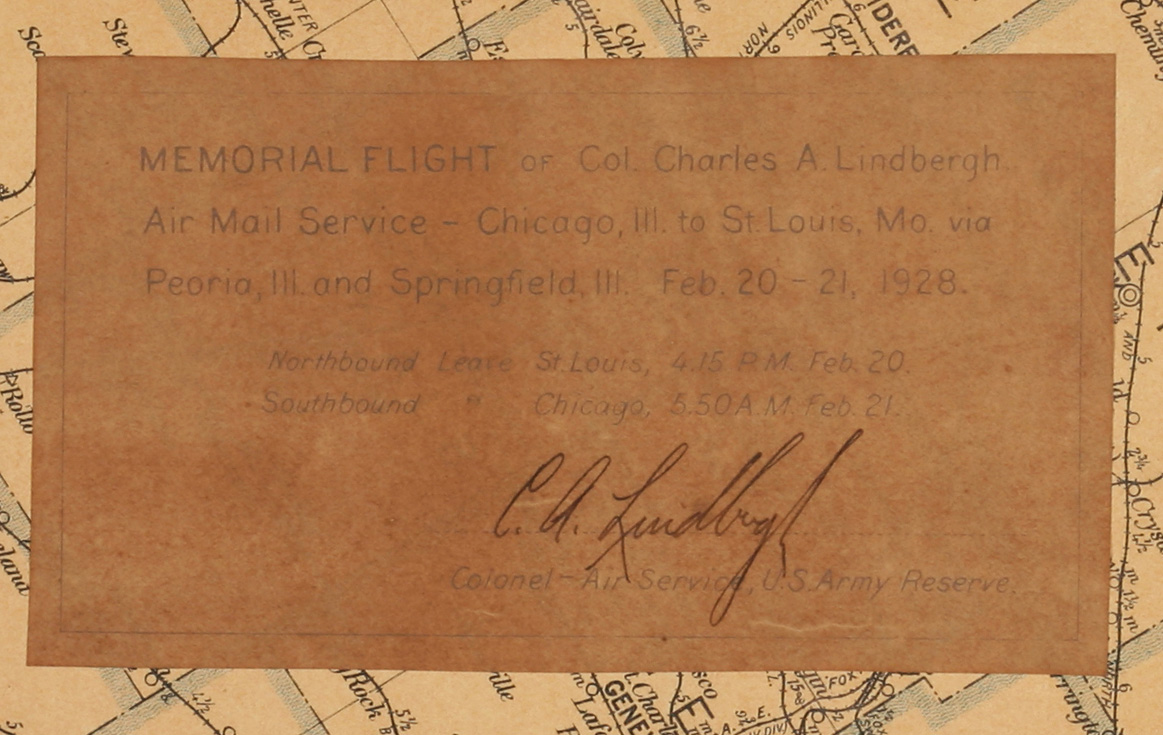
In 1925, Congress passed the Kelly Act, which authorized the Post Office to contract with commercial air carriers to create and maintain new airmail routes. The first two Contract Air Mail Routes were inaugurated on Feb. 15, 1926. One ran between Detroit and Cleveland, the other ran between Detroit and Chicago.
Charles Lindbergh was a 24-year-old barnstormer and flight instructor living in St. Louis when he was hired by the Robertson Aircraft Company to lay out and fly the newly organized Contact Air Mail Route #2. This route, only the third commercial airmail line in the country, would provide airmail service between Chicago and St. Louis, with stops in Springfield and Peoria.
Robertson Aircraft Corporation won the Chicago-St. Louis air mail route (CAM-2) which included stops at Peoria and Springfield. It began on April 15, 1926. One of its pilots was none other than aviation pioneer Charles A. Lindbergh.
Robertson Aircraft used two DeHavilland DH-4′s to operate the route. The first flight departed St. Louis, stopped in Springfield and then at 6:55am, Lindbergh touched down at Kellar Field. Two planes flew together and the second of these landed just behind Lindbergh. Harlan Gurney, Phillip Love and Thomas Nelson were the other pilots assigned to this route.
Daily flights went smoothly until April 22 when Love smacked his undercarriage on a drainage ditch at the west side of Kellar Field. The propeller and belly of the DH-4 suffered damage so a spare plane was flown up from St. Louis by Nelson. This wasn't Peoria’s first aviation accident, but the first involving a scheduled flight.
The government had introduced sketchy airmail service in 1918 and had extended it coast to coast by 1920. By 1925 the service had added a number of feeder routes. A total of nine such routes crisscrossed the country. Brothers William and Frank Robertson (World War I pilots) from St.Louis operated C.A.M. #2, a government contract airmail route between St Louis (STL) and Chicago by way of Springfield (SPI) and Peoria (PIA). (278 mile route, five round trips a week, beginning on April 15,1926). The government paid by the pounds of mail carried, often the sacks weighed more than the mail inside. Robertson was one of a few aircraft companies to carry mail only. Most also carried passengers to offset costs.
On september 16,1926, in Aircraft #112 Lindbergh departed STL at 4:25pm arriving in Springfield at 5:10pm. After picking up additional mail, Lindy departed for PIA landing at 5:55pm. At 6:10pm Lindy started the PIA to Chicago leg. There was a light ground haze with partly cloudy skies. Darkness came at approximately 25 miles northeast of PIA. A low fog rolled in a few miles northeast of Marseilles, Illinois at the Illinois River. Fog extended upward to 600 feet and Lindy was unable to fly under it. Flying northeast until 7:15pm, a glow on top of the fog indicated a town below near Chicago (Maywood). After circling for thirty-five minutes with no luck in finding the field, Lindbergh headed west to clear Lake Michigan. Flying westerly for fifteen minutes then turning southwest, Lindbergh was hoping to find the edge of the fog bank at the Illinois River. To Lindy's surprise, the engine started to sputter. "I thought the carburetor jets were clogged. There should be plenty of fuel remaining in my main fuel tank. I followed my emergency procedure and switched to my reserve tank." The engine came back to life immediately. " The main tank must be dry." At 8:20pm the main fuel tank was indeed dry and Lindbergh was left with only the reserve fuel. Unable to find a break in the fog, Lindbergh was forced to make his third emergency parachute jump. (From an altitude of 5000 feet) When the engine sputtered and died, Lindbergh jumped out of the right side pulling his ripcord after falling about 100 feet. The Irving Parachute (seat type) functioned perfectly. While descending gently to earth, Lindbergh heard a dreadful sound. The plane's engine (in a nose down attitude) roared to life as the residual fuel in the lines reached the carburetor. Lindbergh had neglected to turn off the engine's ignition switch. It seemed as if the plane was chasing Lindy as he tried to steer his chute away from the plane as it spiraled to earth. The plane was in a left spiral of about a mile in diameter passing approximately three hundred yards away from Lindy, leaving him just outside the circle. Their rate of descent was about the same. The plane made several passes at Lindbergh before he landed in tall corn stalks. Lindy walked in the heavy fog to a farmyard where a carload of farmers had gathered to look for the downed airplane. Lindy had to show the farmers his parachute in order for the men to believe that he was the pilot. After a short search, a neighbor found the crashed plane about two miles away from where Lindy had landed. The plane had skidded along the ground for about eighty yards, gone through a fence and came to rest on the edge of a corn field about a hundred yards short of a barn. The mail was on the ground intact. "The Sheriff from Ottawa arrived and we took the mail to the Ottawa Post Office to be placed on the train to Chicago at 3:00am."After an investigation into the cause of the crash, it was found that a mechanic had removed the 110-gallon fuel tank for repairs and had replaced it with an 80-gallon tank , failing to inform anyone of the change. Instead of being able to return to Peoria and clear skies, Lindbergh ran out of gas while over the fog bank searching for an airstrip.
On November 3, 1926, in aircraft #109, and on the C.A.M. #2 (Contract Air Mail Route #2) route Lindbergh departed STL at 4:20pm and arrived in SPI at 5:15pm. Weather at SPI was 500 feet overcast. After a five-minute stop for mail, Lindbergh headed for PIA. Twenty minutes north of SPI, Lindbergh ran out of sunlight. Light snow had started with the ceiling at 400 feet. Due in PIA at 6:00pm, Lindy was flying into an ice storm that blotted out the lights below. Visibility in Pekin (south of PIA) had dropped to a half mile. Lindy flew on towards PIA at 600 feet where visibility was less than a half mile with a heavy mist and fog. Twice Lindy could see the lights below at 200 feet, but was unable to land. Circling PIA for thirty minutes, Lindy headed northeast towards the Chicago area. Weather earlier that day for a previous flight had shown the ceiling and visibility better in the Chicago area. Having enough fuel for about 1:10 minutes and :20 minutes of reserve, Lindbergh knew going back to STL was impossible even if he could navigate directly. The only lights Lindy saw were on the field at PIA but the fog was just too thick. He flew northeast for thirty minutes at 2000 feet then dropped down to 600 feet. There were numerous breaks in the clouds and occasionally ground lights could be seen at 500 feet. Lindbergh passed over the lights of a small town and a few minutes later came upon a fairly clear area in the clouds. Climbing to 600 feet, he released his only flare, but the parachute connected to the flare caught the plane's tailskid. The flare, torn away from the parachute, plummeted to earth like a rock. For the second time in six weeks, Lindy was left with only one piece of emergency equipment, his parachute. Running low on gasoline (:10 minutes of fuel in the pressure tank) Lindy began climbing heading south towards the less populated areas out in the country. Lindy decided to leave his ship rather than attempt to land blindly. Lindbergh thought if he could see the stars, he would not mind leaping into the storm. The main tank went dry at 7:51pm and the reserve tank dry at 14,000 feet 19 minutes later. At 8:10pm Lindy reported; " I rolled the stabilizer at 14,000 feet and cut the switches."(Remembering the previous jump when he had neglected to turn off the ignition.) Pulling the plane into a stall and just about to go out over the right wing, when it suddenly dropped. Fearing that the plane might strike his parachute, Lindbergh returned to the flight controls. "After righting the plane, I got over on the left side of the cockpit. The airspeed read 70 miles per hour with an altitude of 13,000 feet" (Set Night Jump Record) Lindbergh jumped yanking the ripcord immediately after clearing the stabilizer. The parachute functioned perfectly. "The last I saw or heard of the plane was when it disappeared into the clouds just after my chute opened." Lindbergh floated gently down through snow then rain before coming to earth. Unfortunately the fog was so thick Lindy was unable to see the ground in time to avoid landing on a barbed wire fence on the Robert Runge farm near Covell, Illinois. His borrowed, heavy khaki aviation suit saved him from serious injury. Seeing lights from a small town less than a mile away, Lindbergh with his parachute underarm, walked towards Covell. Lindy entered the Joe Williams General Store to find four men playing cards. "Anyone hear a plane crash?" No one recognized the slim aviator.
By late 1926, the air mail route shifted to new Chicago and Peoria airfields. In 1927, Chicago dedicated its Municipal Airport which would eventually be known as Chicago Midway Airport. Peoria’s Kellar Field was too small for modern aircraft, so in 1926 Alexander Varney opened a new facility known as Big Hollow Airport at what is now Shoppes at Grand Prairie.
August 15, 1927 Chicago to Springfield, Ill.
(Flew via Moosehart, Aurora, Joliet, Peoria, Springfield to St. Louis, Mo. 2 hrs. 35 min.)
Sources:
http://illinoistimes.com/article-14249-when-lindbergh-delivered-airmail-to-springfield.html
http://www.charleslindbergh.com/mystory/thompson.asp
http://peoriastation.blogspot.com/2017/07/pia-history-air-mail-and-charles.html?m=1